Capability detail / material limits
Machining capability, stated in tolerances.
GRIDWORKS quotes from a controlled capability matrix. Probe calibration repeats to ±0.002 mm; production tolerances are assigned by material, geometry, finish, and inspection method.
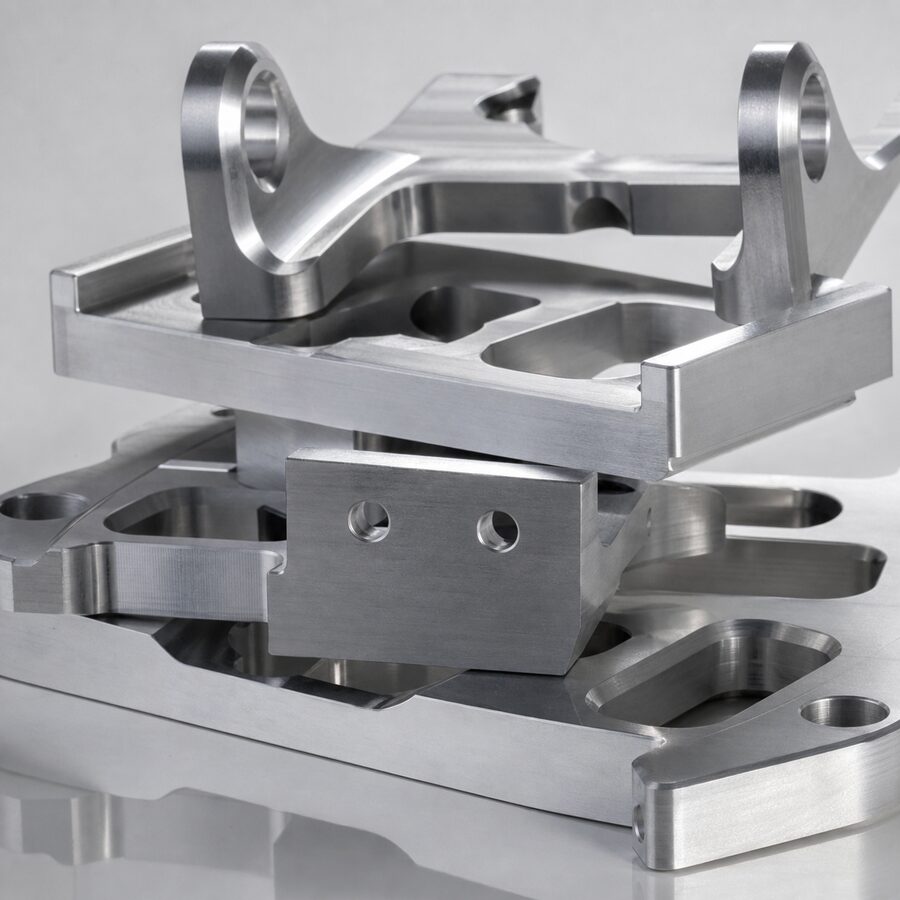 GRIDWORKS / CAPABILITY VISUAL
PROCESS CAPABILITY MATRIX
GRIDWORKS / CAPABILITY VISUAL
PROCESS CAPABILITY MATRIX
Material limits
Baseline machining envelopes by material family.
| Material | Common Grades | Max Envelope | Minimum Wall | Production Tolerance | Thread Range | Best Fit |
|---|---|---|---|---|---|---|
| Aluminum | 6061-T6, 6082, 7075-T6, MIC-6 | 850 x 520 x 410 mm | 1.0 mm with rib review | ±0.008 mm critical features | M1.6-M36 / UNC 0-80 to 1-8 | Housings, robotic brackets, thermal plates, optical mounts |
| Steel | 1018, 4140, 17-4PH, 304, 316 | 640 x 420 x 320 mm | 1.5 mm after stress review | ±0.010 mm critical features | M2-M42 / UNC 2-56 to 1-8 | Shafts, bearing carriers, welded frames, drive components |
| Titanium | Grade 2, Grade 5 / Ti-6Al-4V | 420 x 260 x 220 mm | 1.8 mm with chatter review | ±0.015 mm critical features | M2-M24 / UNF 4-48 to 7/8-14 | Lightweight fixtures, corrosion-resistant plates, high-load links |
Achievable milled finish on selected aluminum and steel surfaces with documented tool path strategy.
Target capability for locked production features after first article approval and control plan freeze.
Recurring production lot range supported by cell scheduling, Kanban buffers, and supplier finishing slots.
Surface treatment options
Finishes tied to measurable thickness, corrosion, and cosmetic criteria.
Type II Anodize
5-18 micron coating, clear or black, cosmetic masking available.
Type III Hardcoat
25-55 micron wear layer for automation tooling and sliding contact parts.
Passivation
Citric or nitric passivation for stainless parts with lot-level bath records.
Electropolish
Bright corrosion-resistant finish for clean assembly and fluid-contact hardware.
Zinc Nickel
High-corrosion coating with 720-hour salt spray target on qualified steel parts.
Powder Coat
RAL color matching, masking fixtures, and abrasion checks for visible panels.
Black Oxide
Dimensional low-build finish for steel tooling, jigs, and non-cosmetic hardware.
Laser Marking
Serialized 2D codes, revision marks, and human-readable lot IDs.
Quality inspection equipment
Measurement systems matched to geometry, finish, and release risk.
Bridge CMM Inspection
Full dimensional reports for datum structures, bore position, flatness, and profile callouts.
Optical Measurement
Fast batch checks for machined plates, stamped features, small bores, and edge distances.
Roughness Verification
Ra, Rz, and directional lay checks for sealing faces, bearing seats, and sliding interfaces.
3D Scan Comparison
Mesh-to-CAD inspection for welded assemblies, organic surfaces, and reverse-engineered fixtures.
Material Confirmation
Incoming alloy verification for stainless, titanium, and plated components before release.
Functional Checks
Thread gauges, torque audits, press-fit checks, and customer-specific assembly verification.
Leadtime guide
Planned around engineering risk and finishing capacity.
DFM Review
Manufacturing review, risk notes, and quote assumptions for complete drawing packages.
Prototype
Single-operation machined parts without outside finishing or complex inspection reports.
Pilot Lot
First 25-100 units with FAI, finish validation, and control plan adjustments.
Production
Released recurring lots with surface treatment, serialized packaging, and scheduled delivery slots.
RFQ checklist
Send the revision-controlled drawing, target volume, material, finish, and inspection requirement.
For fastest response, include annual demand, launch date, current pain point, and whether PPAP, FAI, or customer-format inspection is required.